In this guide
A schedule change is easier to understand as a sequence of days than as a new start time. Rehearse the whole pattern before making arrangements that depend on it.
Obtain the arrangement you are actually changing to
Confirm the reporting time, location, days or rotation and effective point through the employer. Ask whether an initial orientation period differs from the ongoing assignment. Do not substitute a facility’s public opening hours for an employee schedule.
Phoenix’s parks and recreation facilities span several settings. Its PHXPlays page says program locations and schedules vary seasonally. That illustrates why a public program calendar and a staff assignment are different documents. The page’s 2026 summer listing is historical by this article’s October check date.
Draw the old and new weeks without ranking them
On a private planning sheet, mark the confirmed work periods and the personal preparation or travel they require. Use estimated travel time as an estimate, not a guarantee. Include the transition between the last old-pattern day and the first new-pattern day; that is often where an otherwise workable arrangement becomes tight.
Keep sensitive family or health details off shared workplace summaries. If you need to raise a constraint, use the appropriate employer process and disclose what is necessary there. This publication does not decide schedule rights or accommodations.
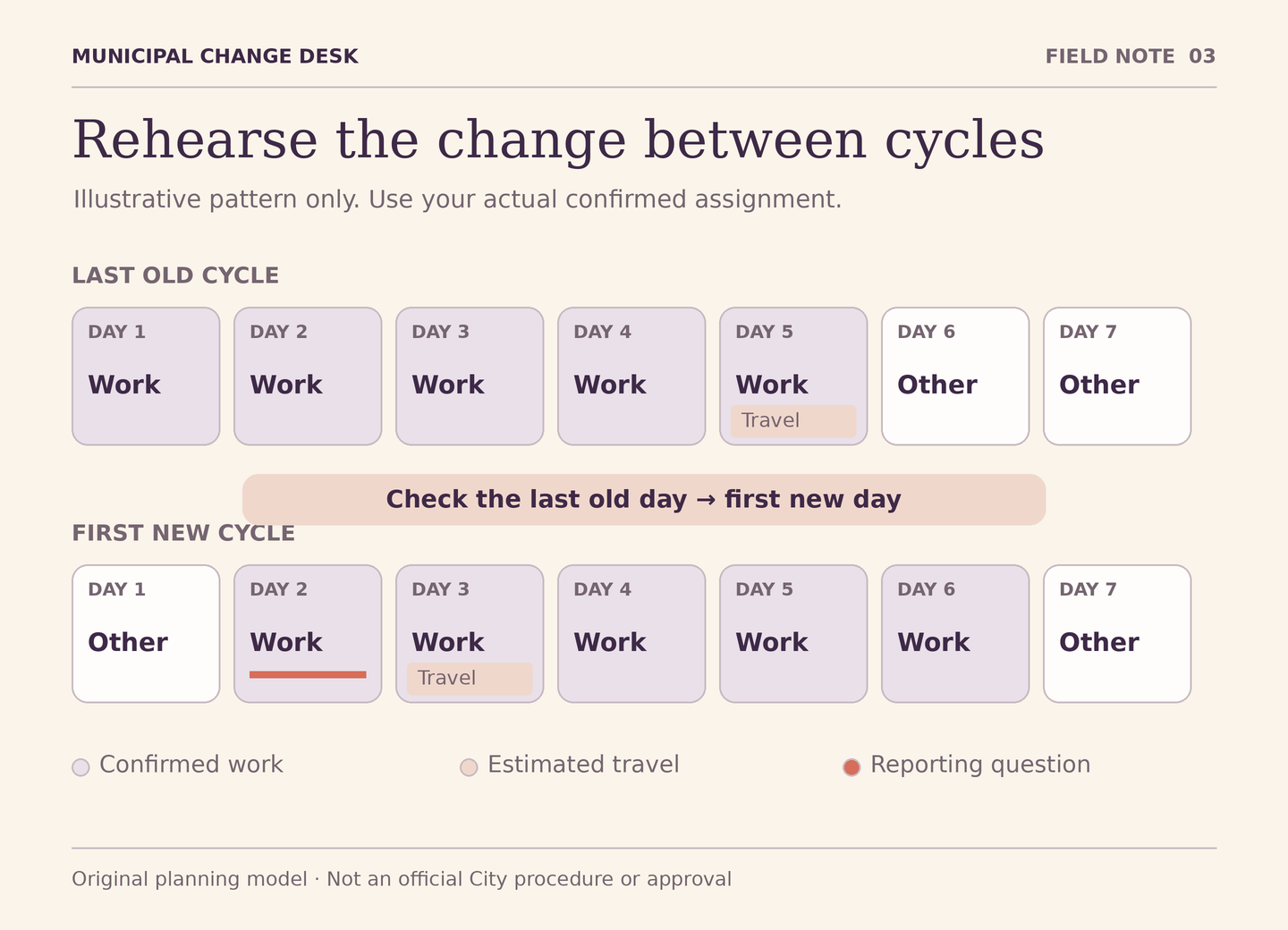
Worked hypothetical: a changed recreation assignment
Imagine an employee moving from one recreation assignment to another with a different reporting pattern. The employee initially checks only whether the new daily start time works. A full-week rehearsal reveals that the first reporting day also uses a different facility, while an old recurring commitment still occupies the previous pattern.
The employee asks the employer to confirm the first-day location and any orientation instructions. Separately, they revise the personal commitment once the new arrangement is confirmed. They do not ask the employer to validate a guessed commute, and they do not treat an unresolved reporting detail as settled. All times and arrangements in this scenario are hypothetical.
Put uncertainties in the right column
One column is for employer questions: who approves a change, which instruction applies, whether a rotation repeats and how a reporting conflict should be raised. Another is for your own planning: travel alternatives, preparation time and personal commitments. A third can hold facts awaiting confirmation from another source.
If pay or schedule provisions are part of the question, use the relevant category in the current compensation materials. Do not carry a provision from a former assignment or another employee group into the new arrangement without confirmation.
Check the first completed cycle
After the change begins, compare the confirmed arrangement with what occurred. A one-time orientation variation need not become your assumed permanent schedule. A recurring difference is worth raising precisely: identify the instruction, the observed difference and the clarification needed.
Your output is a workable first-cycle plan plus a short list of unresolved questions. It is not a prediction of overtime, staffing or emergency assignments. Use the worksite-change brief when place changes with time, and the return-after-absence guide if a changed schedule is part of re-entering an existing role.
Sources and limits
Public sources checked October 5, 2026. Editorial examples are hypothetical; official instructions and case-specific decisions remain with the responsible City service.
- City of Phoenix Parks Activities and Facilities
Public range of recreation centers, parks, pools and other facilities; no employee roster, reporting time or staffing pattern is established.
- City of Phoenix PHXPlays Camps
Public program page states that locations and schedules vary seasonally. Its 2026 summer information is historical context on the October 5, 2026 check date, not a current employee schedule.
- City of Phoenix Total Compensation Information
Current index lists Pay Ordinance S-53059 effective July 6, 2026, 2026–28 agreements and employee-category guides. No individual pay, schedule or entitlement is determined here.