In this guide
An internal move changes two jobs at once: the assignment you are entering and the work you are leaving behind. Plan the boundary between them before trying to prove you can do both.
Write the change in one sentence
Start with the specific proposed change: a different department, assignment, reporting relationship or work location. Do not choose an administrative label such as transfer or promotion merely because it sounds close. Ask the employer to confirm how the action is classified and what authorizes it. The public Human Resources page describes multiple HR functions, but it does not approve a particular move.
Your first sentence can be provisional: “I expect to move from the current assignment to the receiving team, subject to confirmation of the action and effective date.” Under it, keep three short lists: confirmed, proposed and unresolved. A conversation about an opportunity belongs in a different list from a written instruction to report somewhere on a specific date.
Give each date a job
The last day performing an old duty, the employment action’s effective date and the first day reporting to a new supervisor may be different. Access changes, training and handoff acceptance can have their own dates. Ask what each date means instead of collapsing them into “my move date.” A date without an owner is also incomplete: who confirms it, and what happens if it changes?
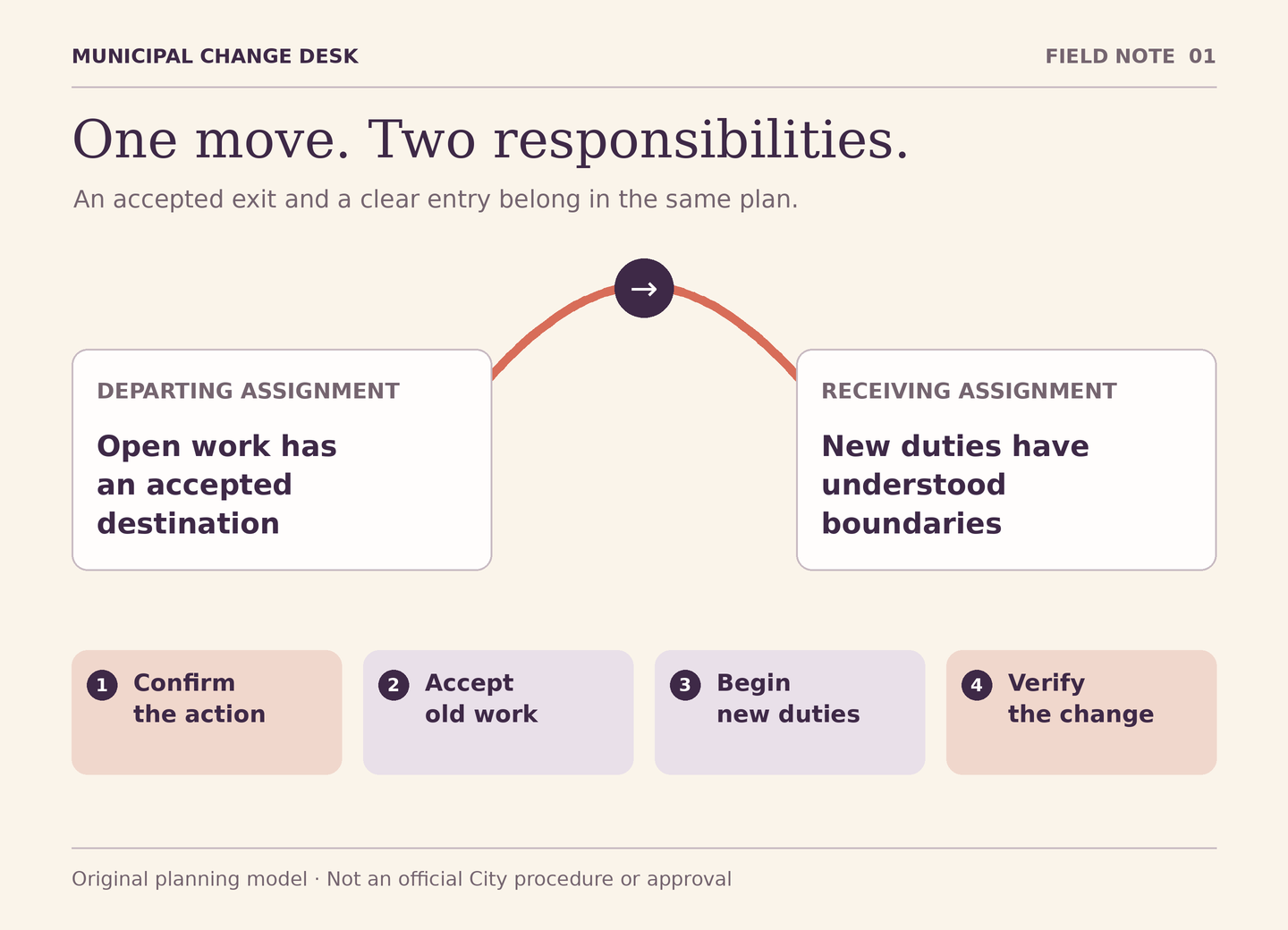
For personal planning, create a short sequence rather than an elaborate countdown. First, establish the approved action. Next, agree the old work’s destination. Then confirm readiness for the new assignment. Finally, review what actually changed. These are editorial planning stages, not required Phoenix intervals or permission to delay an employer instruction.
Check what follows you and what does not
Some facts may remain the same; others need fresh confirmation. Use a change-only review: supervisor, assigned work, location, schedule, employee category, compensation document and required access. Do not assume a new title changes every item, or that remaining with the same employer leaves every item untouched. Record “confirmed unchanged” only when a relevant source or authorized answer establishes it.
The City’s current compensation index lists 2026–28 agreements and category-specific guides. That makes employee category a necessary question when reviewing terms. It does not establish a raise, a schedule right or leave treatment for your move. Keep that uncertainty visible until the applicable documents and official transaction information agree.
Worked hypothetical: fleet support to facilities coordination
Suppose an employee working in a fleet-support assignment is moving to a facilities-coordination assignment. Phoenix Public Works publicly describes both fleet and facilities functions, including maintenance and administrative support. The specific employee, movement and work items in this example are invented; this is not a report of an actual transfer.
The employee has three open vendor inquiries in the old assignment and expects to receive a facilities request list in the new one. Simply forwarding both lists would obscure responsibility. Instead, the departing supervisor identifies the successor for the three inquiries and confirms where the official records remain. The receiving supervisor identifies which new items the employee will own and which need orientation first. The employee records the two acceptances in the authorized workplace location.
One old inquiry has no successor yet. Rather than promising to keep handling it indefinitely, the employee asks both supervisors to resolve ownership and any overlap before the new assignment begins. A bounded overlap, if approved, should identify the exact work, permitted time, reporting arrangement and ending condition. “Help when needed” gives everyone a different picture of the move.
Prepare a first assignment, not an entire reinvention
Ask the receiving supervisor for one bounded output that will show what successful early work looks like. For example, the task might be to reconcile a non-sensitive training example against the current procedure, or to prepare an assigned summary for review. The supervisor chooses real work and safeguards. Your plan should identify what review is needed before the output is relied on.
Prior experience can shorten explanation without carrying authority into a new setting. A person who previously approved a type of request should not assume that approval continues after moving. Ask who decides, who checks and who receives the completed work in the new assignment. The first-weeks authority check develops this distinction in more detail.
Make the last conversation concrete
Before the transition, bring a small set of unresolved dependencies to the people responsible. A useful agenda is: “These two old items still need an owner; this new task needs access; this date is proposed rather than confirmed.” That is easier to resolve than “Am I ready?” It also avoids asking one person to answer matters outside their role.
- What is the approved action and its effective date?
- Who accepts each unfinished responsibility from the old assignment?
- Which new duties may begin immediately, and which require preparation or authorization?
- Which terms or records should be checked after the action is processed?
- Who should hear about a mismatch, and through which official route?
Close the move with evidence
After reporting to the new assignment, compare the plan with reality. An old mailbox still accessible, an unchanged display label or a task still addressed to you is a signal to clarify, not permission to keep exercising the old role. Conversely, a changed system display alone does not establish that every handoff is complete.
Keep the completion test narrow: the old responsibilities have an accepted destination, the new responsibilities are understood, and discrepancies have reached the appropriate official channel. Use the old-role handoff for outgoing work and the eCHRIS transition boundary for the difference between system evidence and the employment decision itself.
Sources and limits
Public sources checked October 5, 2026. Editorial examples are hypothetical; official instructions and case-specific decisions remain with the responsible City service.
- City of Phoenix Human Resources Department
Public description of HR functions and official contact entry point; not a transfer approval, onboarding procedure or individual case determination.
- City of Phoenix Total Compensation Information
Current index lists Pay Ordinance S-53059 effective July 6, 2026, 2026–28 agreements and employee-category guides. No individual pay, schedule or entitlement is determined here.
- City of Phoenix About Public Works
Public scope of solid waste, fleet and facilities functions. Used to ground hypothetical workforce transitions, not to describe a verified internal handoff process.