In this guide
- Describe the actual change before reacting to its name
- Preserve the service while changing the owner
- Worked hypothetical: a water-infrastructure coordinator changes teams
- Track commitments made under the previous arrangement
- Test the new reporting line with decisions, not biographies
- Agree how the overlap ends
- Hold a short exception review after the switch
- Sources and limits
An organization chart can change in one announcement. The responsibility for an unresolved request, a scheduled review or a promised update needs a more precise handover.
Describe the actual change before reacting to its name
A new supervisor, a renamed unit and a reassigned function are different events. Start with the change explicitly communicated to you. Identify the decision maker, effective date and duties affected. Keep unanswered questions separate from the announcement itself. Do not infer a Citywide restructuring from this article: it is a planning method for a change that your employer has actually communicated.
Phoenix’s department directory describes distinct public missions. It is useful for understanding where an activity sits publicly, but it is not a live internal reporting chart. A familiar department name does not tell you who now approves your work or who has accepted an unfinished assignment.
Preserve the service while changing the owner
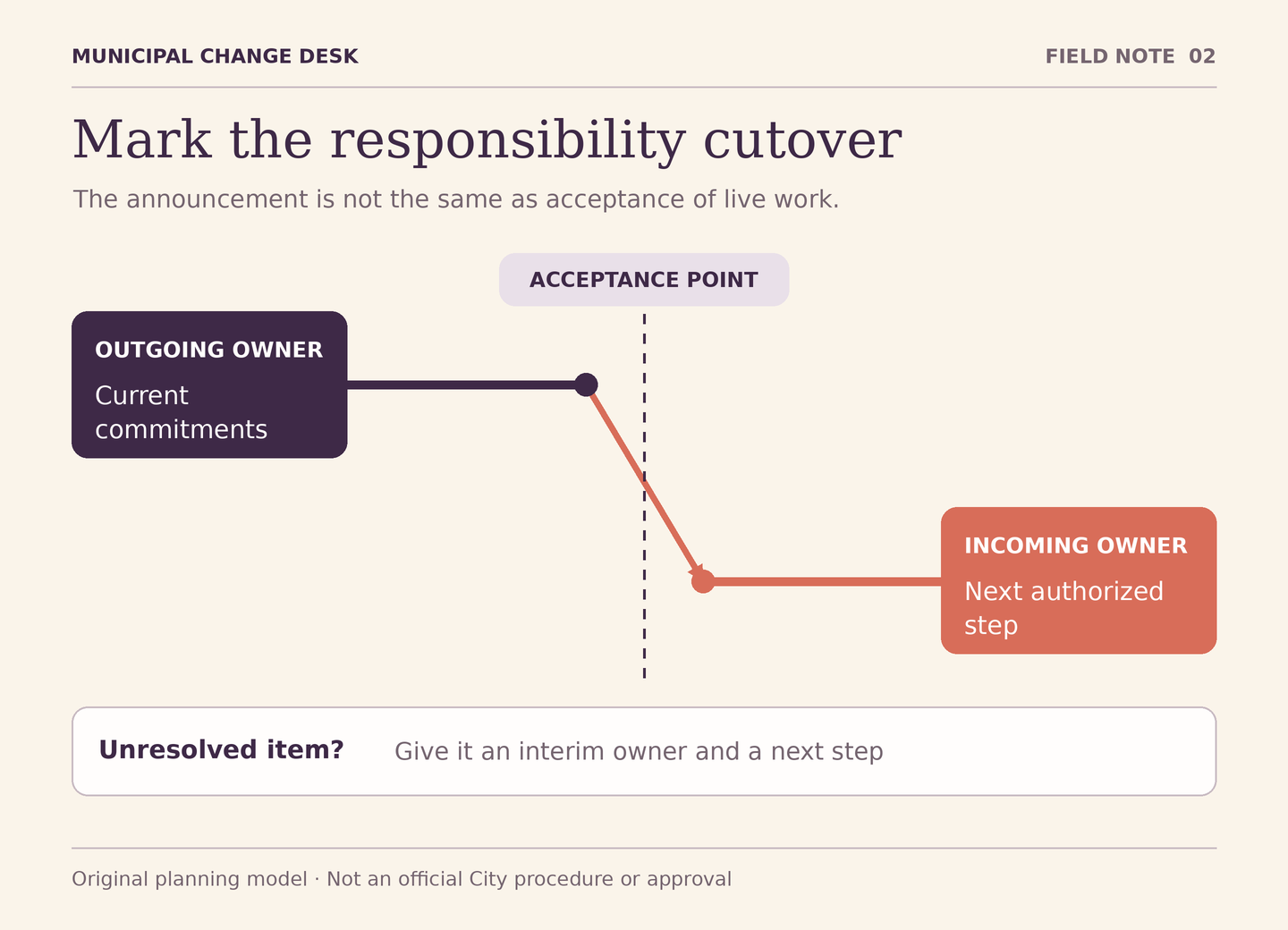
For each responsibility affected by the change, record the outgoing owner, incoming owner, acceptance point and interim decision route. These are functional roles in an authorized workplace record, not names to publish online. The purpose is to expose a gap: an assignment can move in principle while a specific deadline still belongs to nobody in practice.
Start with consequences rather than the size of the file. A small outstanding question may block a larger decision. A recurring report may appear routine but be needed for a scheduled review. Ask what would fail to happen if no one looked at this responsibility between the old and new reporting arrangements.
Worked hypothetical: a water-infrastructure coordinator changes teams
Phoenix Water Services describes infrastructure maintenance and capital planning as parts of its work. Imagine a coordinator whose reporting line changes while an infrastructure project remains underway. The project, people and dates here are hypothetical; no actual Phoenix reorganization is implied.
The outgoing supervisor has been reviewing a weekly project summary. The incoming supervisor will oversee the coordinator starting on an agreed Monday. A meeting on Tuesday needs an update assembled from contributions received before that Monday. The coordinator asks who reviews the Tuesday material, where the previous review comments remain and who can resolve a missing contribution. The title change alone answers none of these questions.
The agreed plan might leave the outgoing supervisor responsible for one final review before the transition, with the incoming supervisor accepting the subsequent cycle. If that plan is not approved, the coordinator keeps the review ownership question open and escalates it through the established reporting route. The employee does not create their own authority to release the material.
Track commitments made under the previous arrangement
Make an authorized list of commitments that cross the change date. Include the promised output, its recipient, the basis for the date and the person who can change it. A commitment is not erased because the person supervising it moved. At the same time, an employee should not reconfirm every old promise without checking whether the authorized plan has changed.
Use three labels: continuing as confirmed, proposed for revision, and awaiting a decision. A revised date belongs in the first group only after the proper person approves it and any required communication occurs. Do not silently overwrite the original commitment; retain the relevant history within the official system so the new owner can understand the change.
Test the new reporting line with decisions, not biographies
Knowing who your new supervisor is helps, but knowing which questions they can resolve helps more. Choose three decisions likely to arise in your actual work: prioritizing an assignment, accepting a completed output and handling an exception. Confirm the decision route for each. Some may follow the new supervisor; others may remain with a specialist function or established authority.
This matters in work tied to public meeting cycles. The City Clerk’s public scope includes Council agendas and meeting notices. A hypothetical administrative employee changing teams around such work would need confirmed review responsibilities and actual applicable instructions. This article supplies no meeting deadline, legal interpretation or authority to issue a notice.
Agree how the overlap ends
An overlap can be useful if it has a clear purpose. It becomes confusing when both supervisors continue assigning work independently. Ask for a shared understanding of which assignments take priority, how conflicts are raised and what ends the overlap. A training walkthrough, accepted status review or specified final deliverable may be a sensible endpoint if the employer agrees.
Do not assume that access to a previous team’s files means you should continue editing them. Access, responsibility and approval are separate questions. The change plan should route needed access changes through the employer’s authorized process, without sharing passwords or creating personal copies of restricted material.
Hold a short exception review after the switch
Once the new arrangement is operating, review the items that did not transfer cleanly. Look for work still addressed to the outgoing person, decisions waiting on the wrong supervisor and recurring obligations absent from the receiving team’s view. Bring specific examples through appropriate internal channels rather than describing the whole change as a failure.
The review is complete when each exception has an accepted owner or an explicit decision about what happens next. It is not complete merely because every employee attended a meeting. If a significant responsibility remains unresolved, record the blocker and use the established escalation path; do not invent a workaround that exceeds your authority.
Your practical output is a one-page change brief containing the confirmed change, crossing commitments, outgoing and incoming acceptance, unresolved decisions and next review point. Taking over an existing workload narrows this to the new owner’s first review. A project-lead change addresses the special case of a departing coordinator and an approaching milestone.
Sources and limits
Public sources checked October 5, 2026. Editorial examples are hypothetical; official instructions and case-specific decisions remain with the responsible City service.
- City of Phoenix City Departments
Public department missions and links, checked October 5, 2026; not an internal reporting chart or assignment instruction.
- City of Phoenix About Water Services
Public description of water, wastewater, infrastructure maintenance and capital planning; no technical operating procedure or employee authorization is reproduced.
- City of Phoenix City Clerk Department
Public scope includes Council agendas, meeting notices, records and licenses; no records-retention rule or employee authority is inferred.