In this guide
- Decide what kind of departure you are discussing
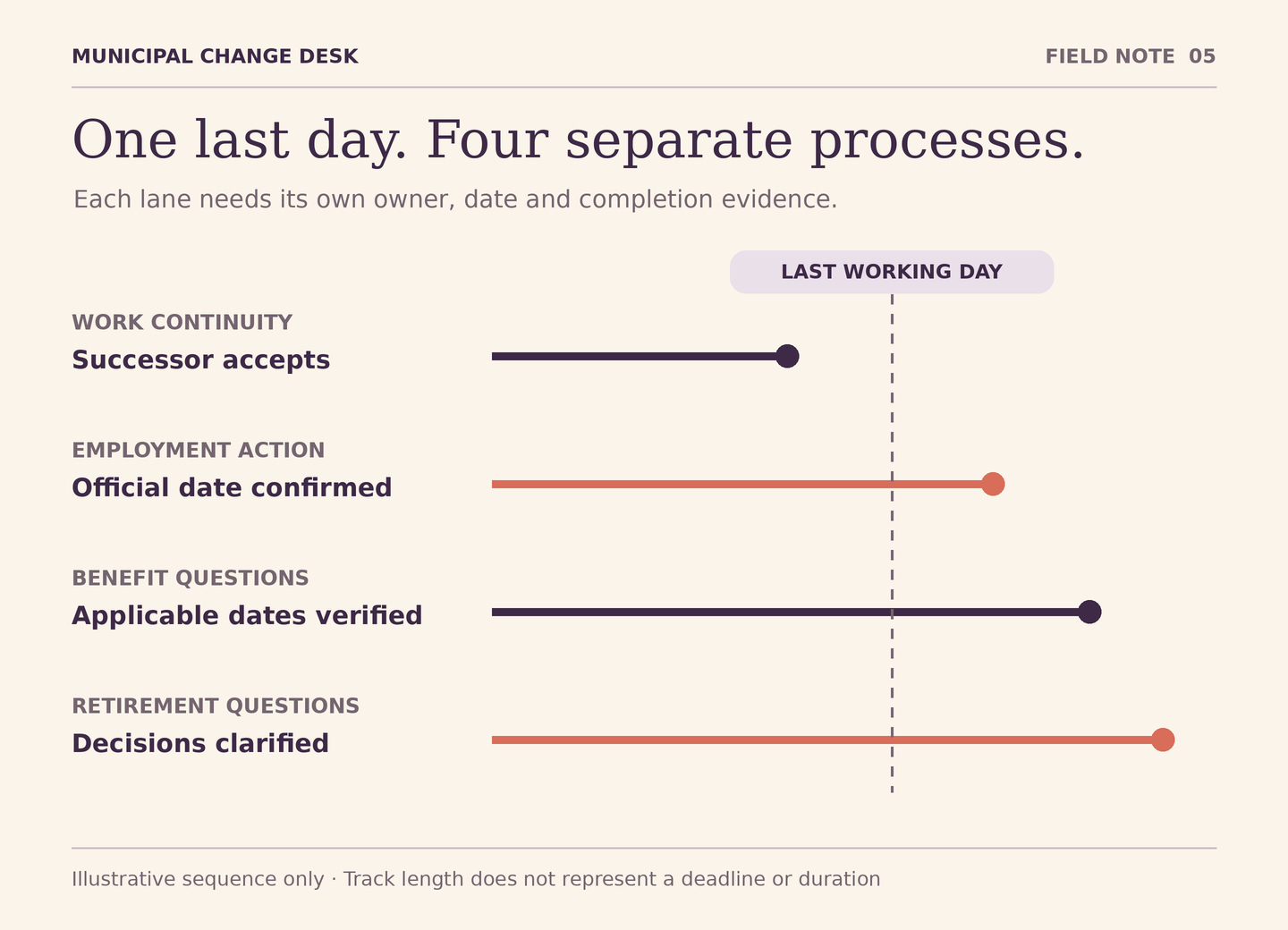
- Create four lanes with separate owners
- Worked hypothetical: leaving a City administrative role
- Work backward from dependencies, not invented deadlines
- Do not treat a retirement refund as routine exit paperwork
- Preserve access to your own information appropriately
- Leave one clear route for legitimate remaining matters
- Use completion evidence for each lane
- Sources and limits
Leaving a position can end your day-to-day duties before every employment, benefits or retirement question is settled. Plan the separate processes without assuming they share one deadline.
Decide what kind of departure you are discussing
A move within the City, a temporary absence, resignation and retirement are different situations. Begin with the action actually proposed or approved. Do not use a departure checklist to determine your rights, final pay or pension treatment. Those questions depend on the applicable rules and official records.
If you are still considering leaving, mark dates as planning assumptions. If the action has been confirmed, record the official date and its meaning. A last day physically working, an employment separation date and a benefit end date should not be treated as synonyms.
Create four lanes with separate owners
The first lane is work continuity: unfinished duties, recurring obligations, records and a successor’s acceptance. The second is employment administration: the official action, required steps and access to appropriate personal employment documents. The third is benefits: which coverage questions apply and where to obtain an official answer. The fourth is retirement or other savings arrangements, if relevant to your membership and situation.
The public HR entry page and benefits page help identify official functions and audiences. They do not establish that a single request completes every lane. Keep a question with the office or role responsible for answering it rather than expecting one supervisor to determine all outcomes.
Worked hypothetical: leaving a City administrative role
Imagine an employee who has decided to leave an administrative assignment connected with public meeting support. Phoenix’s City Clerk functions include agendas and meeting notices, so unfinished preparation can outlast an individual employee’s role. The employee and departure in this example are fictional.
The employee has one meeting-related task due after the proposed last working day. They identify the current record, outstanding decision and successor through the employer’s process. The successor’s acceptance addresses the work lane. It does not answer when benefits end or whether any retirement action is appropriate.
Separately, the employee asks the official benefits function which current instructions apply to the planned separation and how any required notices will be provided. They ask the retirement office relevant to their membership about the consequences of the available choices. Each question has its own source and confirmation. No coverage period, payment amount or retirement entitlement is assumed.
Work backward from dependencies, not invented deadlines
For each lane, ask which step depends on another. A document request might depend on a processed employment action; a successor’s access might need an authorized request; an individual benefits question may require a confirmed separation date. Identify these dependencies early so they can be addressed through the actual process.
Use real deadlines only when a current applicable source or official instruction supplies them. Add the audience, event and time basis beside the date. If a source is unclear, seek clarification promptly rather than calculating your own deadline from an unrelated example. This publication’s planning sequence is not an extension of any official requirement.
Do not treat a retirement refund as routine exit paperwork
The COPERS Retirement Guide linked by the City is marked updated July 3, 2023. Its refund section warns that accepting a refund cancels the person’s rights and benefits in COPERS. That makes a refund a consequential decision to clarify with COPERS and, where appropriate, qualified financial or tax advice. It is not a box to tick merely because employment is ending.
The guide is a dated summary, and membership matters. Do not apply it automatically to another retirement system or assume that returning later would restore the same position. Keep a distinction between learning about options, requesting an estimate and electing a transaction. This article recommends no withdrawal, rollover, pension option or retirement date.
Preserve access to your own information appropriately
Ask which personal employment documents you may obtain, through what official method and when access changes. Follow the employer’s instructions. Do not export resident information, colleague records, internal case files or confidential operational material to preserve a personal history of the job.
For property and account changes, use the actual return and access process. A generic checklist should not tell you to delete work records or close an account. Identify the relevant owner and obtain confirmation that the required action is complete. Keeping a record of a completed return is different from keeping the property or credentials themselves.
Leave one clear route for legitimate remaining matters
Where the official process requires contact information or a communication preference, provide it through the verified channel. Ask how to receive relevant notices or resolve a discrepancy after the separation. Do not assume continuing employee-system access or promise unlimited unpaid assistance to the former team.
For work questions, the successor should become the ordinary contact. If a bounded final clarification is appropriate and approved, define it. The old-role handoff provides a practical way to keep continuity without leaving the departed employee as the permanent backup.
Use completion evidence for each lane
Before calling the departure plan finished, identify what you know and what remains pending: work accepted, official action confirmed, property instructions completed, benefits questions answered or assigned, and retirement decisions still deliberately open where appropriate. A pending consequential choice should remain visible instead of being concealed by a “done” checkbox.
The final output is a small departure record with dates, source references and unresolved questions, stored appropriately. Retirement questions in the right order expands the retirement lane. Rejoining City work explains why a future return should be investigated on its current terms rather than assumed from the position you leave.
Sources and limits
Public sources checked October 5, 2026. Editorial examples are hypothetical; official instructions and case-specific decisions remain with the responsible City service.
- City of Phoenix Human Resources Department
Public description of HR functions and official contact entry point; not a transfer approval, onboarding procedure or individual case determination.
- City of Phoenix Benefits
Official benefits entry page separates employee and retiree resources and links to eCHRIS; no private account access was used.
- COPERS Retirement Guide, updated July 3, 2023
2023-dated guide currently linked from the Retirement Office page on October 5, 2026. Tier-specific summary and refund warning; verify current rules and individual membership with COPERS.
- City of Phoenix City Clerk Department
Public scope includes Council agendas, meeting notices, records and licenses; no records-retention rule or employee authority is inferred.